NEW DELHI — A movement that began as an online joke transformed into a major public demonstration on June 6 as thousands of young Indians gathered at Delhi’s Jantar Mantar, demanding accountability from the government and the resignation of Education Minister Dharmendra Pradhan.
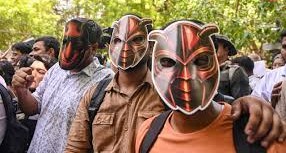
The protest, organized by the Cockroach Janata Party (CJP), drew supporters from across the country and marked the movement’s first large-scale appearance beyond social media. Participants carried books, waved Indian flags, and wore cockroach masks, embracing a symbol that was originally intended as an insult.
The movement was sparked after Chief Justice Surya Kant reportedly compared unemployed young Indians critical of the authorities to cockroaches during a court hearing. The remark prompted Abhijeet Dipke, a recent Boston University graduate and political communications strategist, to launch a satirical political platform online under the name Cockroach Janata Party. What began as parody quickly evolved into a nationwide expression of frustration over unemployment, examination scandals, and concerns about democratic freedoms.
Addressing the crowd after arriving from the United States, Dipke urged young people to challenge what he described as government indifference toward their concerns. “The future of this country is its youth,” he said, warning that public anger would continue unless accountability was ensured.
The protest centered on demands for the resignation of Education Minister Dharmendra Pradhan, whose ministry oversees several national examinations. Demonstrators cited recent controversies involving alleged irregularities in school board assessments and the cancellation of a major medical entrance examination following reports of a paper leak. Protesters argued that recurring exam scandals have undermined confidence in India’s education system while leaving students to bear the consequences.
Many attendees had travelled long distances to participate. Seventeen-year-old Saurav Kushwaha journeyed overnight from a village in Madhya Pradesh with his brother. Having recently completed his school-leaving examinations, he said he was frustrated by repeated controversies surrounding the education system and uncertain about his future prospects.
Others joined in solidarity despite not being directly affected by the exam disputes. Mohammad Aftab, a 28-year-old delivery worker from the Delhi region, said he gave up a day’s wages to attend the demonstration. Wearing a cockroach mask, he said students deserved public support after years of studying for examinations that were repeatedly marred by controversy.
Authorities maintained a heavy security presence throughout the day. Police and paramilitary personnel lined surrounding streets, and uncertainty remained until shortly before the event over whether permission would be granted. Despite the precautions, the six-hour demonstration concluded peacefully without major incidents.
The movement’s rapid rise has been driven largely by social media, where its humorous memes and satirical commentary have attracted millions of followers. Supporters describe the cockroach as a symbol of resilience and survival, turning a perceived insult into a badge of collective identity.
While critics dismiss the phenomenon as a fleeting online trend unlikely to produce lasting political change, supporters argue it reflects deeper frustrations among India’s youth. With nearly half of the country’s 1.4 billion people under the age of 25, the protest highlighted growing concerns over education, employment opportunities, and political representation. Whether the movement can sustain its momentum beyond social media remains uncertain, but Saturday’s turnout demonstrated its ability to convert online engagement into a visible force on the streets of the capital.
(Compiled From various Agencies report)