Bengaluru, May 13 (IANS) The Karnataka government on Wednesday withdrew its February 5, 2022, order on school and college uniforms and issued fresh guidelines permitting students to wear "limited traditional and faith-based symbols" along with prescribed uniforms in educational institutions across the state.
The move is likely to trigger a controversy in the state.
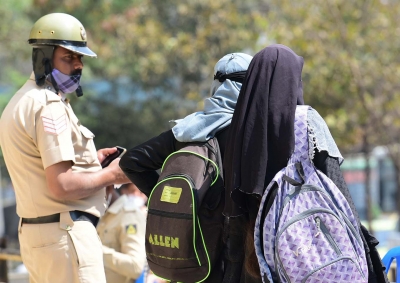
The decision comes weeks after an April 24 incident in which a student's sacred thread ('Janeu') was allegedly cut at a school and a hijab was removed during the Common Entrance Test (CET) triggering public outrage and renewed debate over religious symbols in classrooms in the state.
Announcing the decision, Karnataka School Education and Literacy Minister Madhu Bangarappa said the state government acted following directions from Chief Minister Siddaramaiah, who emphasised that all religions and faiths must be respected and that students should not face stress while attending school.
Minister Bangarappa added: "The government order issued in this regard specifically mentions turbans, sacred threads, Shiva beads, Rudraksha, headscarves/hijabs and similar commonly worn religious symbols as permissible. However, such symbols should not interfere with discipline, safety or identification of students."
"Children come to school only for education, and we have to deliver that. They come with their own religious traditions. From today onwards, there are specific rules," the Minister told reporters.
He also clarified that recent textbook revisions undertaken by the state government were aimed at benefiting children and were not directed against any particular community.
According to proceedings issued by Under Secretary S.N. Padmini of the Department of School Education and Literacy, the new order seeks to ensure "uniformity, equality, secularism and equal education" in all schools and colleges.
Invoking Sections 7 and 133(2) of the Karnataka Education Act, 1983, and Rule 11 of the Karnataka Educational Institutions Rules, 1995, the state government formally revoked the Government Order dated February 5, 2022, with immediate effect.
The revised guidelines mandate that all government, aided and private schools, as well as pre-university colleges, continue enforcing prescribed uniforms as per institutional requirements and government directives.
At the same time, students will now be allowed to wear "limited traditional and custom-based symbols" along with uniforms, provided these do not alter or defeat the original purpose of the uniform.
The government order specifically mentions turbans, sacred threads, Shiva beads, Rudraksha, headscarves/hijabs and similar commonly worn religious symbols as permissible.
However, such religious symbols should not interfere with discipline, safety or identification of students.
The state government has also directed that no student should be denied entry into educational institutions, classrooms, examination halls or academic activities for wearing such religious symbols alongside the uniform.
The government order prohibits forcing students either to wear or remove religious or traditional symbols. However, dress codes prescribed for national and state-level examinations will continue to apply during examinations.
The state government instructed the School Development and Monitoring Committees (SDMCs), College Development Committees, and heads of institutions to ensure the rules are implemented uniformly and without discrimination.
It also warned institutions against any discriminatory or humiliating behaviour toward students.
The order said that institutions should adopt an inclusive approach inspired by the philosophy of social reformer Basavanna and ensure that no student is denied access to education.
Any institutional circular, rule or directive contrary to the new government order has been declared void.
The state government also said it had examined dress code regulations followed in Kendriya Vidyalayas and found that institutional discipline could be maintained without restricting limited traditional or faith-based symbols.
"Secularism in the constitutional sense does not mean opposition to individual beliefs. It is equal respect for all, impartiality and non-discriminatory treatment," the order said.
"It is essential to strike a balance between institutional discipline and constitutional values such as equality, dignity and the right to education," it added.
The order has come into immediate effect across Karnataka.