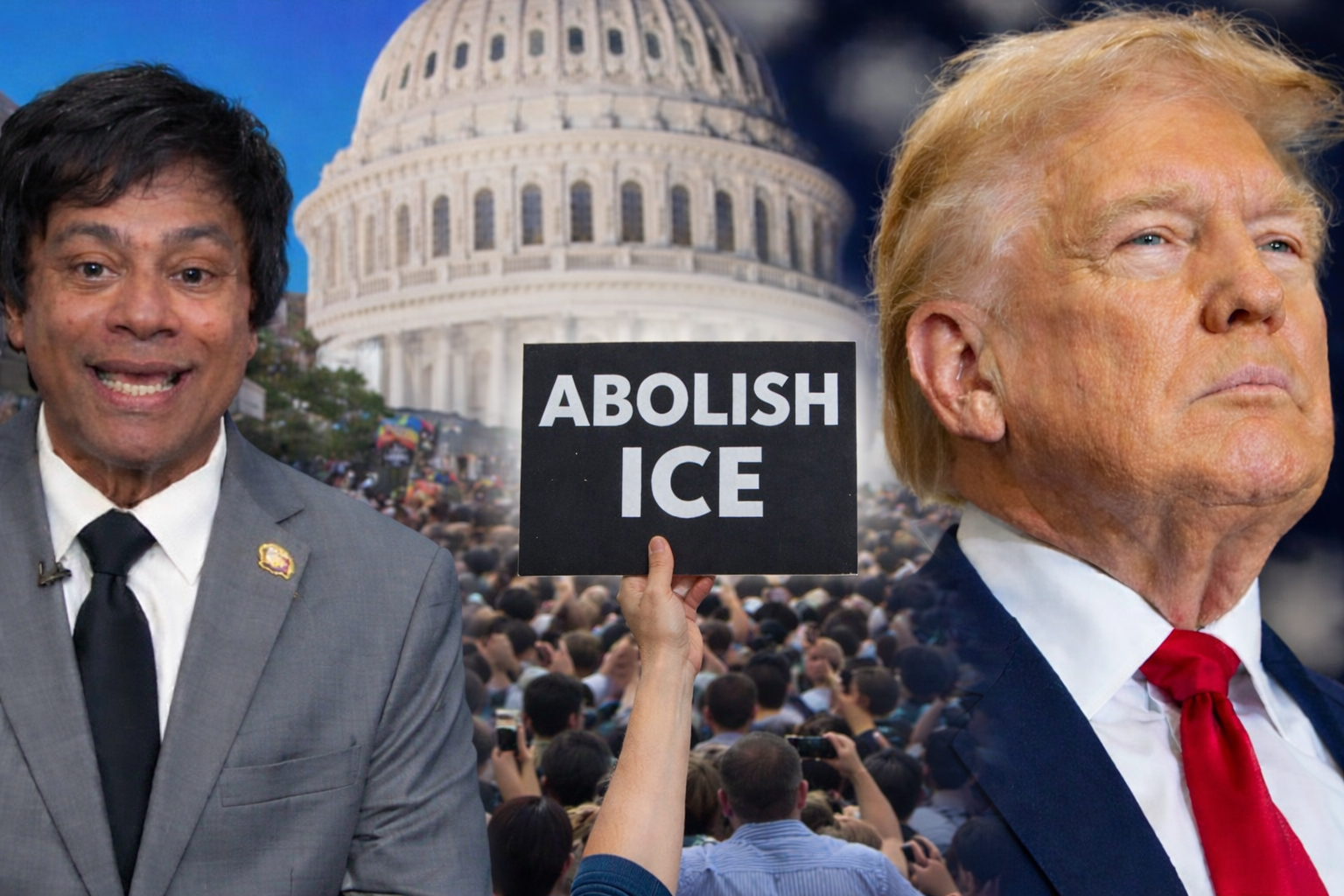
Washington: Congressman Shri Thanedar of Michigan’s 13th Congressional District has introduced the Abolish ICE Act, legislation that would dismantle U.S. Immigration and Customs Enforcement (ICE), immediately halt its funding, and formally abolish the agency within 90 days of enactment. The proposal arrives at a moment of national outrage, mass protests, and renewed debate over the role of immigration enforcement in the United States, following a series of deadly encounters involving ICE agents and a broader crackdown under the Trump administration.
Since its creation in 2003 as part of the newly formed Department of Homeland Security, ICE has been tasked with locating, detaining, and deporting undocumented immigrants. Legal experts and civil rights advocates have long argued that the agency’s structure prioritizes aggressive enforcement over due process, often operating with limited transparency and accountability. Congressman Thanedar echoed these concerns in announcing the bill, stating that ICE has “prioritized aggressive enforcement and violence rather than due process,” leaving Americans—citizens and immigrants alike—living in fear. He emphasized that prior reform efforts, including his own legislation to end qualified immunity for ICE agents, failed to prevent abuses, concluding that the agency is “beyond reform.”
The immediate catalyst for the legislation was the killing of Renee Nicole Good, a U.S. citizen and mother of three, who was shot and killed by a masked ICE agent in Minneapolis on January 7, 2026. According to witnesses, Nicole was sitting in her vehicle when agents approached and attempted to remove her without clearly identifying themselves or explaining their purpose. Fearing for her safety, she attempted to drive away and was fatally shot. Bystanders who tried to provide life-saving assistance were reportedly pushed back and prevented from helping as Nicole died at the scene. Her death ignited nationwide protests, with thousands marching under the rallying cry of “abolish ICE.”
Nicole’s killing was not an isolated incident. In 2025 alone, ICE operations were linked to multiple deaths and large-scale raids that fueled public anger. On July 10, 2025, an ICE raid on two cannabis farms in Camarillo, California, resulted in the arrest of 360 workers and the death of one laborer. In September of the same year, ICE agents shot and killed Silverio Villegas Gonzalez during a traffic stop shortly after he dropped his children off at school. Days later, a military-style raid in a Chicago apartment building—dubbed “Operation Midway Blitz”—led to 37 arrests, the use of flashbang grenades, forced entry with explosives, and civilians being zip-tied, partially unclothed, and loaded into unmarked vans. On New Year’s Eve 2025, an off-duty ICE officer shot and killed Keith Porter Jr. during celebrations in Northridge, California.
Beyond shootings, conditions in ICE detention facilities have drawn severe criticism. In 2025, 32 detainees died in ICE custody, the highest number in more than two decades, with reports citing inadequate medical care and neglect. That same year, as many as 170 American citizens were mistakenly arrested and detained by ICE, a figure publicly denied by Homeland Security Secretary Kristi Noem despite documented cases. Roughly 70 percent of ICE arrests in 2025 involved individuals with no criminal record, underscoring concerns that enforcement priorities have shifted toward mass deportations rather than public safety.
The Abolish ICE Act argues that immigration enforcement responsibilities can be carried out by other federal agencies without the culture of militarized policing that has come to define ICE. The bill would immediately bar federal funds from being used for ICE’s operations, rescind unobligated balances, transfer remaining assets and liabilities to the Secretary of Homeland Security, and formally dissolve the agency 90 days after enactment. While largely symbolic given Republican control of Congress and the near certainty of a presidential veto, the legislation marks one of the most forceful challenges to ICE’s existence in recent years.
Thanedar’s announcement also exposed the racialized backlash that has accompanied the debate. Following his press conference, MAGA-aligned commentators targeted him with racist rhetoric, mocking his accent and calling for his deportation. Right-wing influencer Nick Sortor derided him as an “Indian Rep. who can barely speak English,” while commentator Eric Daugherty urged that he be “sent back.” Thanedar responded by reaffirming his stance, declaring that the United States does not need a “paramilitary organization” terrorizing communities and that ICE, in its current form, must “go away.”
The renewed push to abolish ICE reflects a broader resurgence of a movement that first gained national attention in 2018 during protests against family separations under Trump’s first term. Rooted in police and prison abolition theories advanced by scholars such as Angela Davis, the movement was built over years of grassroots organizing led by undocumented immigrants and civil rights advocates. While the slogan briefly entered mainstream Democratic politics, it later fell out of favor amid fears of electoral backlash, even as deportations continued under subsequent administrations.
Today, however, public opinion appears to be shifting. A recent Economist/YouGov poll shows that for the first time, more U.S. adults support eliminating ICE than oppose it. Progressive lawmakers, activists, and even some conservative commentators have joined the call, framing abolition as a necessary step toward restoring due process and human rights. Immigrant rights organizers argue that the current moment represents both a reckoning and an opportunity to imagine a system that prioritizes community safety without mass detention or deportation.
For supporters, the Abolish ICE Act is not merely about dismantling an agency, but about confronting what they see as the weaponization of immigration enforcement to sow fear and hysteria. As protests continue and chants of “abolish ICE” echo across cities, the debate has become a defining fault line in America’s ongoing struggle over immigration, civil liberties, and the rule of law. Whether or not the bill advances, Congressman Thanedar’s proposal has thrust that struggle back into the center of national politics, challenging lawmakers and the public alike to reckon with the human cost of the current system.
(With the input of Congressman Shri Thanedar (.gov) and The Guardian)