By Prashant Shah
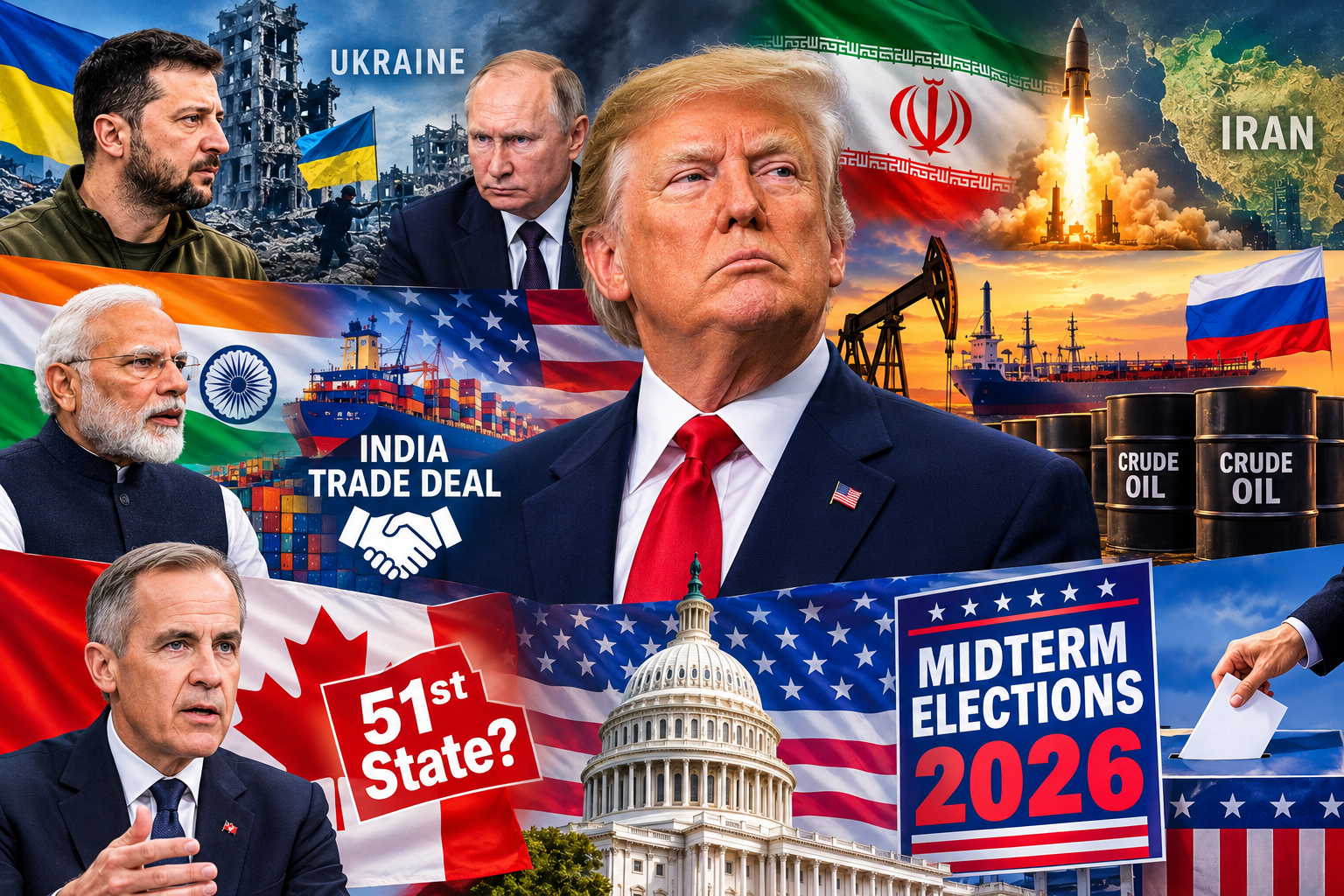
President Donald Trump’s foreign policy is increasingly defined by dramatic reversals, forceful declarations and negotiations that often leave allies and adversaries uncertain about Washington’s next move. From his changing approach to the war in Ukraine and threats against Iran to the contradictions surrounding Russian oil, trade negotiations with India and his repeated suggestion that Canada should become America’s 51st state, Trump’s words and actions are raising important questions about the consistency of American leadership.
These developments are not merely diplomatic controversies. They affect international security, energy prices, trade, the cost of living and America’s relationships with countries that have traditionally regarded the United States as a dependable partner. As the November 2026 midterm elections approach, the central political question is whether voters will interpret Trump’s approach as tough, unconventional deal-making or as evidence of an unpredictable presidency that creates more uncertainty than stability.
Trump entered office promising to put America first, end costly foreign entanglements, secure better trade agreements and make other countries respect American power. His supporters see his willingness to challenge established diplomatic practices as a strength. Critics argue that constantly changing positions can undermine confidence in American commitments and make it difficult for allies to plan for the future. The difference between these interpretations may prove crucial at the ballot box.
The most striking example of this uncertainty is Trump’s changing position on Ukraine. He initially presented himself as the president who could end the war quickly by bringing Russian President Vladimir Putin and Ukrainian President Volodymyr Zelenskyy to the negotiating table. Yet, as the conflict has continued, Washington’s approach has shifted repeatedly between supporting Ukraine, pressuring Kyiv to make concessions and seeking economic accommodation with Moscow.
In October 2026, relations between Washington and Kyiv deteriorated further. Trump criticized Zelenskyy, urged Ukraine to stop attacking Russian energy infrastructure and temporarily eased certain restrictions affecting Russian fuel. Ukraine and its European supporters fear that these moves could weaken Kyiv’s bargaining position and reward Moscow without securing meaningful Russian concessions. Russia’s continued attacks, including a major missile assault on Kyiv, have reinforced doubts about whether diplomatic overtures alone can persuade Putin to end the war.
Trump’s defenders may argue that ending the conflict requires difficult compromises and that American taxpayers should not carry an indefinite financial burden. That argument deserves consideration. However, there is a fundamental difference between negotiating a durable peace and pressuring the invaded country to accept an unfavourable settlement. Any agreement that rewards territorial conquest could encourage other powerful nations to believe that military aggression will eventually bring political gains.
European leaders have responded with growing alarm. French President Emmanuel Macron has warned against capitulation, while German Chancellor Friedrich Merz has emphasized the need to maintain support for Ukraine. Italian Prime Minister Giorgia Meloni has criticized the Russian diesel arrangement as a risky decision that could undermine sanctions. European Union foreign policy chief Kaja Kallas has also expressed concern that Ukraine is being pushed towards surrender on Moscow’s terms.
Nevertheless, European governments have not abandoned cooperation with Washington. They recognize that American military capabilities, intelligence and diplomatic influence remain important to European security. Their challenge is to preserve the transatlantic alliance while preparing for the possibility that the United States may no longer be as dependable as it once appeared. If European countries conclude that American commitments can change abruptly with presidential preferences, they may accelerate defence spending and develop greater strategic independence.
Trump’s confrontation with Iran presents another serious test. On October 24, reports described renewed threats of American military action unless Tehran reached an agreement with Washington. Trump warned of another round of military operations, even as uncertainty persisted about whether a new strike had been authorized. The conflict, which began with American and Israeli attacks in February 2026, has spread across West Asia and created considerable concern about regional security and energy supplies.
A president must be prepared to deter genuine threats, including those involving nuclear proliferation and attacks on American personnel or allies. Yet threats of renewed warfare carry consequences beyond the immediate confrontation. Iran could retaliate against American interests, regional partners or critical infrastructure. Any escalation could disrupt shipping through strategically important waterways, increase oil prices and intensify instability across the Middle East.
For ordinary Americans, the consequences would be measured not only in military expenditure but also in petrol, diesel, transportation and grocery bills. Trump promised to reduce the cost of living, and an extended conflict that raises energy prices could undermine that promise. His administration must therefore explain what its military objectives are, what conditions would bring the conflict to an end and how it intends to prevent another prolonged regional war.
The controversy surrounding Russian oil and diesel makes the administration’s policy even more difficult to explain. Trump has criticized Russia’s war against Ukraine and, at various points, threatened economic penalties against countries purchasing Russian energy. Yet his administration has now moved towards easing certain restrictions and arranging Russian diesel supplies. Reporting published in October describes the arrangement as a major source of friction with Ukraine and European governments.
The administration can argue that energy security and lower fuel costs require practical decisions, particularly when international markets are under pressure. But the contradiction is evident: if purchasing Russian energy helps finance Moscow’s war effort, how does expanding such transactions advance the objective of ending that war? Conversely, if Washington considers energy purchases necessary to protect American consumers, it must explain why the same economic realities should not be recognized when other countries make their own energy decisions.
India has particular reasons to watch this development closely. New Delhi has sought affordable energy supplies while maintaining its strategic independence and working to strengthen its relationship with Washington. American pressure over Russian oil purchases has complicated trade negotiations and raised concerns about punitive tariffs.
On October 19, Reuters reported that Trump had waived certain Russia-related sanctions and tariff measures, a move that could ease India’s energy concerns and create additional room for a trade agreement. US Secretary of State Marco Rubio said negotiations were very close to completion, although important issues remained unresolved.
Trump has also indicated that a US-India trade deal is approaching. For India, the opportunity is substantial: improved access to the American market could support exports, investment and employment. For the United States, stronger economic ties with India could strengthen supply chains and deepen cooperation with an important Indo-Pacific partner.
But can India confidently rely on American commitments when tariff threats and sanctions policies can change so rapidly? A trade agreement must be judged by its final terms, not by presidential declarations. India will need clarity on tariffs, market access, energy purchases and the treatment of its exporters. Washington, meanwhile, must recognize that India is an independent country with its own economic priorities and geopolitical interests.
A mutually beneficial agreement could strengthen both democracies. An arrangement based on repeated threats, shifting conditions and uncertain enforcement could instead encourage Indian businesses to diversify their markets and make New Delhi more cautious about depending excessively on Washington.
Canada faces a different but equally revealing challenge. Trump’s repeated suggestion that Canada should become America’s 51st state has strained relations with one of the United States’ closest neighbours. Canadian Prime Minister Mark Carney has firmly defended his country’s sovereignty while criticizing the economic consequences of American tariffs. Recent reporting indicates that Canadian leaders continue to regard the US relationship as increasingly difficult to predict.
Canada is an independent country with its own democratic institutions, government and national identity. The two countries share an extensive border, deep commercial ties and close security cooperation. Disagreements over trade are legitimate, but suggestions of annexation risk turning an economic relationship into a question of national dignity.
Such rhetoric can also have practical consequences. Canadian businesses may seek alternative markets, while consumers and manufacturers on both sides of the border could bear the costs of trade disputes. A country that has traditionally been among America’s closest partners should not have to question whether economic cooperation will be accompanied by threats to its sovereignty.
Ultimately, these international developments will feed into America’s November 3, 2026, midterm elections. Republicans must defend their congressional majorities while voters evaluate the administration’s performance on inflation, employment, immigration, healthcare, energy costs and national security.
Foreign policy rarely determines every vote, but it can become decisive when international crises affect household finances. Higher fuel prices, uncertainty for American businesses and concerns about an expanding military conflict could weaken Republican support. The administration’s handling of Ukraine may also divide voters between those who oppose further American commitments and those who believe abandoning allies would damage US credibility.
Democrats, however, cannot assume that dissatisfaction with Trump will automatically translate into electoral victories. They must offer credible alternatives on the economy, security and international relations. Voters may support a tougher negotiating strategy while still demanding evidence that it produces measurable results.
A Democratic victory could constrain Trump’s domestic legislative agenda and intensify congressional scrutiny of his policies. It would not automatically reverse his foreign policy, since presidents retain considerable authority over diplomacy and national security. Nevertheless, a changed balance of power in Congress could increase pressure for greater transparency and accountability.
The larger question is what kind of global leadership America wishes to exercise. Tough negotiations are not inherently wrong, and changing a policy in response to new circumstances is not necessarily a failure. Diplomacy requires flexibility. But flexibility without consistency can become unpredictability, and unpredictability can erode trust.
Trump’s challenge is to demonstrate that his U-turns are part of a coherent strategy rather than a succession of short-term reactions. Can he secure peace in Ukraine without rewarding aggression, deter Iran without provoking an uncontrolled war, protect American consumers without undermining his own sanctions policy, conclude a fair trade agreement with India and preserve a respectful relationship with Canada?
The midterm elections will offer voters an opportunity to judge not only his domestic record but also the consequences of his approach to the world. America’s strength rests on more than military power, tariffs and presidential declarations. It also depends on economic stability, credible commitments, dependable alliances and the confidence that American policy will not change dramatically from one day to the next.
In the final analysis, the test of Trump’s leadership is not how forcefully he makes a threat or how dramatically he announces a deal, but whether his actions produce lasting peace, economic security and international confidence. If his policies deliver those results, his supporters will claim vindication. If they generate higher costs, weakened alliances and greater uncertainty, voters may decide that America first should not mean America increasingly isolated.
(With the input of Agencies reports)