Santosh Kumar Verma
New Delhi, Jan 4 (IANS) The history of 19th-century India, as chronicled through the records of its foreign rulers, is a study in paradox. While the British East India Company (EIC) claimed to govern for the "welfare and happiness of the inhabitants", providing "new and valuable property" and administering justice, the reality inferred from the parliamentary debates in London was far darker: a system burdened by immense debt, a stifled native press, and a fundamental relationship where Indians were viewed not as fellow-subjects, but as those whom the British were "despots over".
No single conflict encapsulated this profound contradiction more completely than the Pindari War of 1817–1819. In the hallowed halls of the British Parliament, the campaign was championed by Mr. Canning -- the President of the Board of Control -- as a necessary measure of "self-defence against the aggressions of the Pindarries". Yet, in the same breath, Canning articulated the chilling truth that defined British hegemony: the "irrepressible tendency to expansion" of the Indian empire, where the only visible alternative to constant aggression was "conquest or extinction".
From the Indian perspective, this doctrine of "irrepressible expansion" was not a natural phenomenon, but a carefully constructed political and military justification for the systematic elimination of the subcontinent's remaining sovereign powers. It was a war that India was forced to fight, and forced to pay for, ensuring that the burden of imperial ambition fell squarely on the colonised people.
The Financial Crucible of Conquest
To understand the compulsion behind the British need for perpetual conquest, one must first examine the EIC's precarious financial foundation. By the early 19th century, the EIC was no longer simply a trading corporation; it was a behemoth that wielded sovereign powers -- military authority, administrative control, and the right to tax. This powerful entity, however, was perpetually sinking in debt.
The immense territorial revenues extracted from India were "largely consumed by the costs of the British administration and its military activities". The interest-bearing debt, which stood at nearly seven million pounds in 1793, had exploded to an estimated 26 million pounds by 1813. This staggering financial burden, contracted often for the "defence and protection" of the very possessions it was acquiring, meant that conquest was not merely desirable for strategic growth, but utterly essential for economic survival.
Canning's justification that expansion grew out of a "struggle for existence and security" rings hollow when viewed through the Indian lens, which saw its own wealth systematically drained to support this ruinous "privatized imperialism". The profits from trade since 1793 (6,289,405 pounds) had been entirely absorbed by "debts and expenses incurred in respect of the territorial acquisitions in India".
Thus, the "irrepressible tendency to expansion" was not an unfortunate political reality but a desperate, self-feeding mechanism whereby the EIC, unable to sustain itself on trade or existing revenues, had to constantly acquire new territories to pay off its previous wars and sustain its administration. India was paying the cost of its own subjugation.
The Pindari Scourge as Imperial Pretext
The direct catalyst for the war was indeed harrowing. The Pindarries were described by Canning as an anomalous force "without recognized government or national existence". Their aggressions were marked by "unparalleled atrocities". Accounts detailing their raids speak of “rapine, murder in all its shapes, torture, rape, and conflagration".
The sources record horrific acts: the torture of innocent people to extort hidden treasure, and the ultimate desperation of the populace, leading to instances where the entire female population of a village "precipitated themselves into the wells as the only refuge from these brutal and barbarous spoilers".
In 1816, a particularly brazen incursion into Madras territory, costing nearly a million sterling in plunder and waste, finally determined the government at home to act.
Canning argued that this situation demanded action, driven by the need for the "vindication of national honour, and the discharge of national duty". The British government, having effectively supplanted native rulers who might have sympathized with the victims, now had a "sacred duty" to avenge the injuries.
However, the Indian perspective interprets this moralistic justification as a calculated pretext. The war, while nominally against scattered banditti, was universally recognized by the British administration as a calculated risk: eliminating the Pindarries meant running the risk of stirring up "all the elements of a restless and dissatisfied population" and potentially provoking the major Mahratta powers.
This conflict was therefore designed not merely to police the border, but to destroy the entire remaining structure of indigenous military power. As parliamentary critics noted, the war led directly to the "further dismantling of existing native polities and the expansion of direct or indirect British control".
The Pindari War was merely the necessary operational phase for the "irrepressible tendency to expansion" to manifest itself fully, ensuring that no major Indian state remained capable of challenging the EIC’s burgeoning empire.
The Illusion of Sovereignty and the Extinction of Rivals
The British knew that prosecuting the Pindari War meant confronting the great Maratha chiefs, whom they suspected of having a "deep-laid conspiracy for striking a blow which should at once overthrow the British power".
The vulnerability of the Maratha states stemmed from the fact that they were already politically neutralized by British policy. Lord Morpeth, a critic in Parliament, pointedly questioned whether rulers like the Peshwa could be expected to show gratitude when they had been stripped of real power, left with a "barren sceptre," and subjected to "the mockery of independance". The British Subsidiary Alliance system had effectively hollowed out their autonomy.
It was this background of political suffocation that led to the inevitable explosion: the Peshwa, followed by the Rajah of Nagpore, unexpectedly broke their "most solemn engagements" with treachery and violence.
This hostility, though unanticipated by some British officials, was the desperate, predictable reaction of sovereigns who realized that the British peace policy was merely consolidation before the final takeover.
The result of the ensuing conflicts was the swift destruction of the Maratha military structure, sealed by decisive victories like the one led by Brigadier-General Smith against the Peshwa’s concentrated army. By cornering the Maratha chiefs, the British ensured that the Pindari "horde had ceased to exist as a body" within three months of the campaign opening.
The ultimate conclusion of the war was thus the consolidation of British power, fulfilling the prophecy of "conquest or extinction" -- not for the British, but for the native polities themselves.
The Double Standard of Justice and Honour
The British claim that the war was fought to maintain "national honour" and apply "principles of justice" is dramatically undermined by the contemporaneous debates over how that justice was applied in India.
A specific and alarming incident that reached the floor of Parliament concerned the military conduct of General Sir Thomas Hislop following the capture of Talnier fort. After the fort was taken and the garrison put to the sword, the Killedar (commander), who had already surrendered, was deliberately executed.
This act sparked intense debate, as critics argued that the Killedar could not be summarily punished for treason by British authority. As Lord Lansdowne noted, under "every rule of European war," proof of the Killedar's complicity in continued resistance was required, and, crucially, accountability for rebellion rested solely with his native sovereign (Holkar), not the British.
The debate, which forced the House of Commons to reserve its opinion on the execution, highlighted that British notions of "justice and humanity" were highly selective, demanding that the British legislature apply them to India as they would in Europe. The failure to universally apply these standards demonstrated that the rule of law in India was subordinate to the dictates of military and imperial convenience.
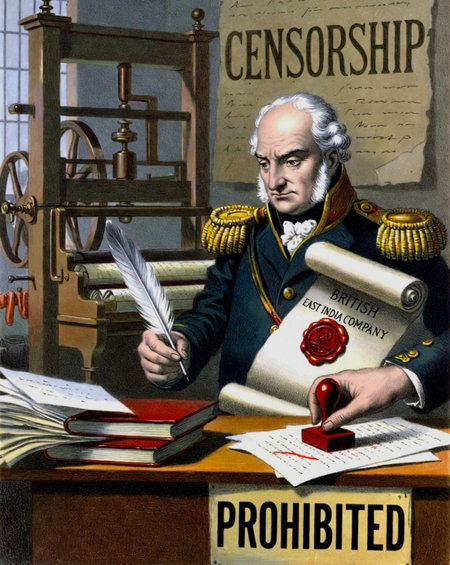
This selective application of "honor" was reflected in the EIC's rigorous control of information. The press in India was "perfectly fettered", requiring the sanction of government secretaries before publication. Why? Because the administration feared that open discussion could "excite irritation and hostility" among the natives by criticizing religion or informing them "of the peculiar tenure by which the British government held their power".
The critics opposing the censorship were unequivocal: "Nothing could be more dangerous than freedom of discussion under a government founded upon blood and supported by injustice". The entire imperial structure, therefore, depended on keeping the populace in a state of darkness regarding the true nature of the rule.
The Irrepressible Economic Exploitation
The "irrepressible tendency to expansion" was ultimately tied to a parallel, "irrepressible tendency" toward economic exploitation that crippled India's indigenous economy. While the EIC amassed territory, the financial and commercial benefits flowed primarily outwards.
The existence of the EIC's trade monopoly was viewed by British merchants and manufacturers across the kingdom as "unjust" and a hardship "bordering on injustice".
Petitions detailed how foreigners, particularly American merchants, enjoyed a freer and more successful trade with British possessions in India and China than most British subjects themselves. This demonstrated that the monopoly existed not for commercial efficiency -- as American individual enterprise proved superior -- but to serve the EIC's unique hybrid status as ruler and merchant.
This meant that India's economic potential was systematically stifled. The use of Indian resources, such as its excellent timber for shipbuilding, was restricted to protect British domestic industries, a practice deemed an act of "injustice and oppression" that denied India the benefit of its "great natural advantages".
British manufacturers feared the loss of their industry and the replacement of British seamen by Indian "Lascars". As critics argued, preventing the use of Indian ships and sailors disadvantaged British merchants and forced the trade towards foreigners.
More generally, Indian resources and wealth were used to fuel Britain's industrial and imperial growth, leading to widespread poverty. The vast market India offered was restricted to a single purchaser (the EIC) or foreign merchants.
As Mr. Wallace argued, the Indian population itself was "deeply interested" in the commerce of its country, as it provided the "reward of his industry, and support of his family". When that reward was channeled away by colonial policy, it created the "widespread poverty and underdevelopment" that characterized the long-term impact of the British administration.
Conclusion: The Triumph of Necessity Over Morality
Mr. Canning's articulation of the "irrepressible tendency to expansion" stands as a rare moment of stark imperial candor. It confirmed the Indian realization that the wars, whether against the Pindarries or the Marathas, were not accidental skirmishes or unfortunate but necessary acts of policing, but rather the inevitable, logical conclusion of a system that demanded "conquest or extinction".
The Indian perspective sees this era not as a triumph of "national honour," but as the final consolidation of a foreign dominion: a hegemony achieved through brutal military efficiency, masked by selective justice (as demonstrated at Talnier), enforced by a fettered press that suppressed truth, and funded by the crippling debt of the very territories being conquered.
The Pindari War resulted in the "extirpation" of the bandits, but simultaneously, it resulted in the extinction of India's last powerful independent polities.
India was left with constrained liberties, its economy shackled to serve British needs, and its true rulers operating under a system that many contemporaneous observers themselves deemed despotic and supported by injustice. The empire survived and expanded, but only by demanding that the Indian people pay the ultimate price of their sovereignty for the "necessity" of the British system.
(The author is a researcher specialising in Indian History and contemporary geopolitical affairs)