By Vaibhav Gaur
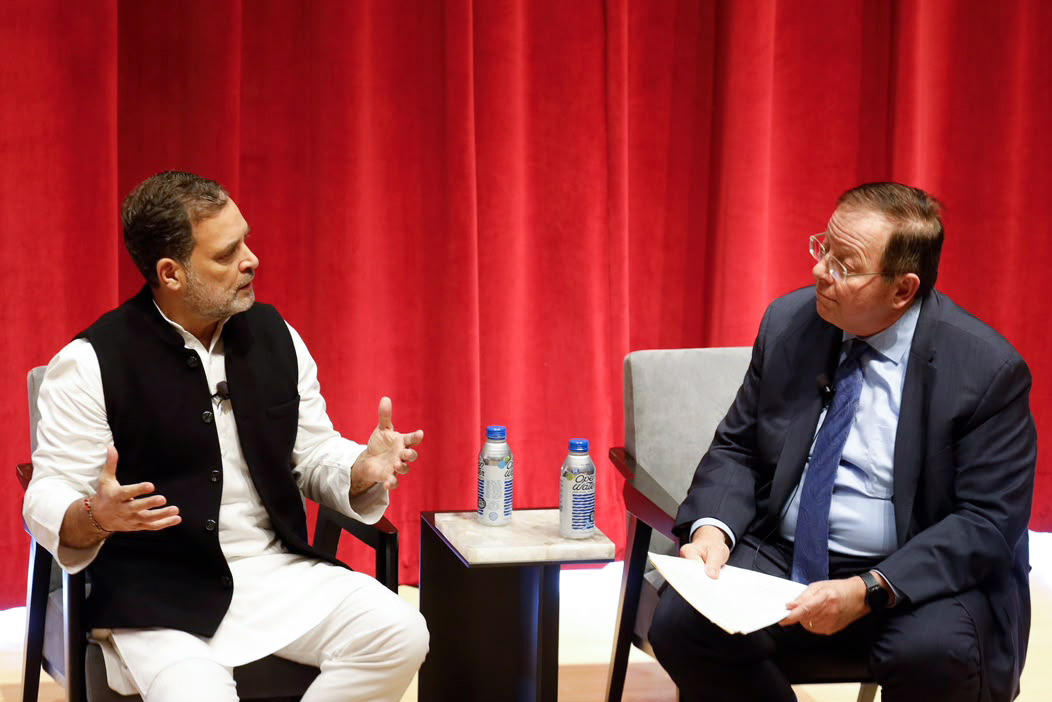
Indian Parliament’s Leader of Opposition in the Lok Sabha, Shri Rahul Gandhi is travelling to the US with academic engagements at Columbia University, and the University of Chicago. On 17th November 2026, Rahul Gandhi in his interaction at Columbia University said that “India is sitting on an economic disaster” and talked of the unemployment problem in India. He went on to raise the questions on the relevance of degrees from prestigious institutions like IITs and IIMs while reiterating his critical comments on industrialists Adani and Ambani. That being said, as an Indian in India, my mind wonders whether the Indian educational institutions, students, and faculty not good enough to meaningfully discuss, let alone counter him with facts of the growth of the economy, the Indian issues for the Leader of Opposition Rahul Gandhi.
What was said- the contents, the subject matter, the format, and the accusations form part of a pattern of Rahul Gandhi’s international engagements at prominent foreign universities, particularly in the United States. Mr Gandhi repeatedly and consciously chooses foreign academic institutional platforms to trace some prominence for his negative articulation of his misinformed and disillusioned assessment of India's political, constitutional, social and economic environment. From the University of California, Berkeley, to Stanford, Georgetown and the University of Texas, his engagements have covered an extensive range of issues concerning India's domestic political landscape.
From speaking upon, and criticizing, domestical political and economic policies/decisions like demonetisation, GST, RTI etc, Mr Gandhi has over the years repeatedly questioned India’s democratic and constitutional frameworks along with raising critical comments about educational institutions in the country and their alleged erosion. Mr Gandhi has talked of all independent constitutional institutions, manufacturing capabilities, technological transformations, caste, reservations, and institutional inequalities. What is worth noting with emphasis is that Indian Leader of Opposition chooses to, critically comment-discuss-interact about everything about India, in the American institutions, with foreign students and faculty.
India has a massive academic ecosystem comprising of central universities, IITs, IIMs, law universities, social science institutions and independent research centres. These institutions exist as the living spaces where constitutional ideas, political ideologies, public policy, economic models, and competing interpretations of Indian democracy and constitutionalism are debated and facts get separated from rhetorics. They also provide a natural and relevant setting for engaging with Indian students, researchers and academics who can interrogate political claims against the country's constitutional framework, historical experiences and empirical realities. As a matter of fact, Indian academic institutions can actually have better fireside chats that Mr Gandhi engages in, with the Indian students present in the audience, the students who actually know the country, the context, and the issues that are to be discussed.
Mr Gandhi has, admittedly, interacted with students at some Indian academic institutions, including Mount Carmel College, Stella Maris College, Delhi University and St Teresa's College. However, it must be carefully noted, that the interactions in Indian campuses are either with selective group of students, closed door, informal, or speech format ones rather than the “fireside chats” with the diverse (politically, economically, socially) audiences in an open format. The more pertinent question is whether these interactions constitute a sustained and comparable academic engagement, particularly when set against the visibility of his appearances at internationally recognised universities.
There is also a larger question of political communication. When a prominent Indian opposition leader, an international representative of Indian political opposition, discusses the rhetorical weakening of India's democratic institutions, the alleged marginalisation of social groups or the disinformed opinion about failing economy before international audiences, these arguments inevitably contribute and influence how the international academic community understands, perceives, and interprets India's domestic political environment. Such arguments deserve detailed scrutiny from audiences that are relevant, know the contexts, and can provide some constructive counterarguments as per the experiences and realities.
An interaction at an American university can provide international exposure, but an equally substantive discussion at an Indian university can provide direct engagement with the people, institutions and intellectual traditions whose experiences form the subject of the political discourse itself. Quite interestingly, as Mr Gandhi has himself said in his interactions abroad (Hertie School, 2025) that his version of leadership is about listening; so won’t it serve better the purpose to have these interactions in open format with non-political or multi-political audiences in Indian institutions? Discussions on Indian issues can at best be held meaningfully with Indian audiences, if the intention is to have discussion and not beating around the bush.
Ultimately, the question is one of institutional priority and intellectual accountability. Does the country's principal opposition leadership consider Indian universities and Indian students studying in India, equally important platforms for discussing the future of India and Indian democracy? Are India's students and academics being given comparable opportunities to question, challenge, and debate the political and economic arguments being advanced before international academic audiences? In my opinion, the non-politically affiliated Indian audiences do not get such chances on same footing as foreign audiences. The issues Mr Gandhi raises are healthy issues to be debated and they actually could help strengthen democracy in India, but the forums he chooses deliberately for such interactions just serve one purpose: malign India’s name. Indian issues must be debated within India and debated with open and diverse audiences rather than speech delivery format.
India's political future is not a subject of international academic discussion; it is a matter that directly concerns Indian students, scholars, constitutional experts and citizens. Mr Gandhi is well within his discretion to interact with foreign campuses, but those discussions must be on issues that International audiences can comprehend better and not the domestic political issues. The records of his rhetorics and misinformed assertions in the cloak of engagements, in foreign campuses can be described, at best, to be that of fanciful attempts to get some domestic electoral advantage without actually debating at right place, with right audience, and at right time.
Consequently, the expectation of sustained engagement with India's own academic institutions is a legitimate one. The debate should not be about whether Indian political leaders should speak abroad, but whether their engagement with international academic audiences is matched by an equally substantive commitment to intellectual dialogue at home on same issues with open and diverse audiences and in same format where the audience can put forward legitimate questions and not just substantiate his own versions or rhetorics. Indian issues, whatever they are, must be debated at Indian campuses instead of beating the dilapidated drums at non-relevant forums.
(Author is a lawyer and independent researcher based in New Delhi and has avid interest in politics, policy and the world that exists between the two. - The views are author’s very own)