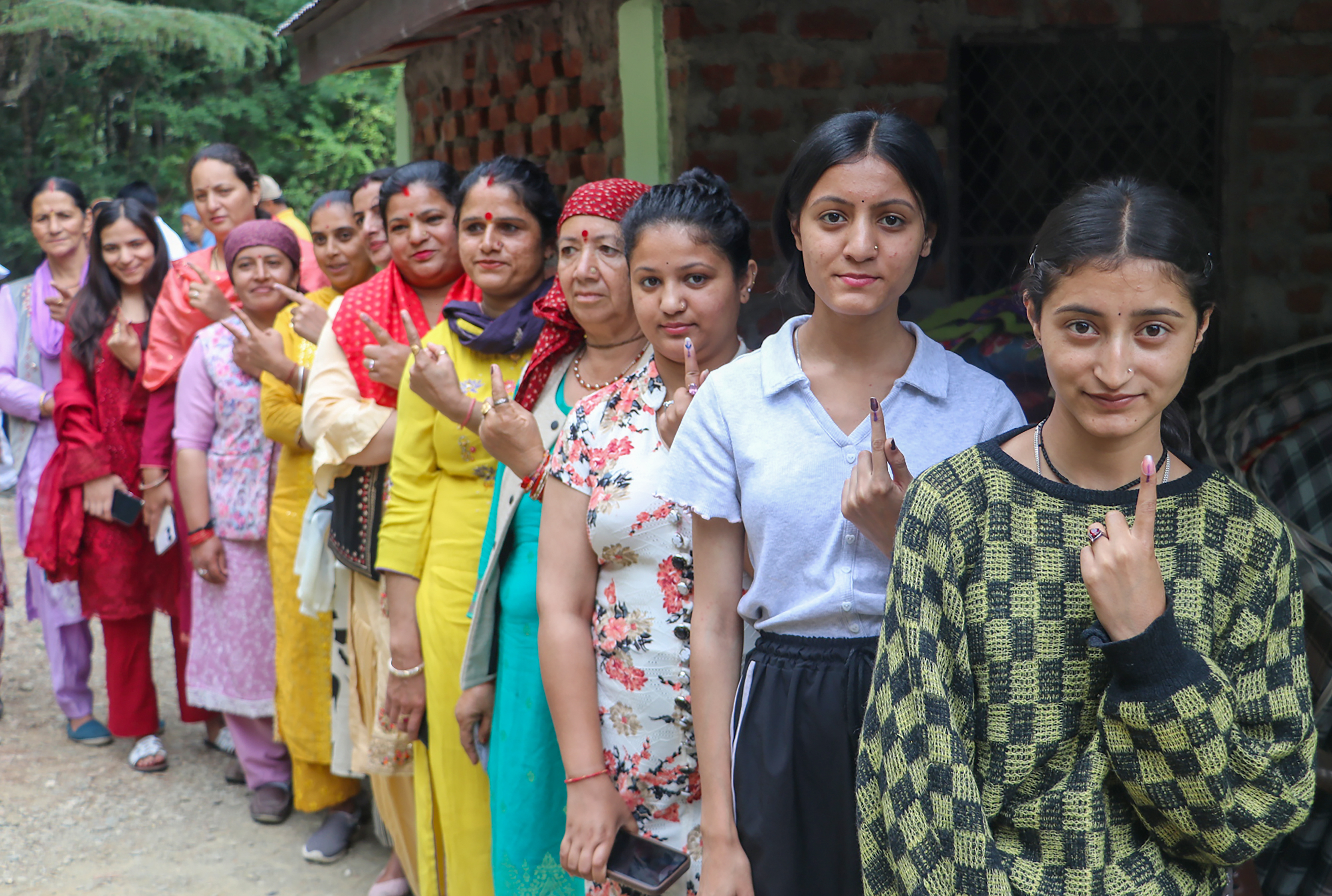
New Delhi, Aug 18 (IANS) Recent state assembly elections in India have recorded voter turnout figures that exceed those of most leading democracies worldwide, according to a comparative chart released by the Election Commission of India (ECI). The data shows several Indian states ranking among the highest globally, reflecting strong public participation in the electoral process.
West Bengal registered the highest turnout at 93.70 per cent, followed by Puducherry at 91.19 per cent, Assam at 88.33 per cent, Tamil Nadu at 86.03 per cent, Kerala at 79.53 per cent and Bihar at 67.25 per cent. These figures show an upward trend, placing Indian states well above most international counterparts.
The countries compared in the chart, along with their approximate turnout percentages based on bar heights, include Switzerland (45 per cent), Japan (54 per cent), Ireland (57 per cent), United Kingdom (60 per cent), Mexico (62 per cent), Italy (64 per cent), United States of America (66 per cent), India national average (67 per cent), Spain (68 per cent), France (70 per cent), Argentina (70 per cent), Canada (68 per cent), Israel (71 per cent), Poland (72 per cent), Taiwan (74 per cent), Austria (75 per cent), Netherlands (77 per cent), Brazil (79 per cent), South Korea (80 per cent), Indonesia (81 per cent), Germany (82 per cent), Sweden (84 per cent), Belgium (88 per cent), Australia (90 per cent) and Singapore (93 per cent).
Six of these countries enforce mandatory voting: Mexico (62 per cent), Argentina (70 per cent), Brazil (79 per cent), Belgium (88 per cent), Australia (90 per cent) and Singapore (93 per cent). Despite the legal requirement for citizens to cast their ballots, turnout still falls short of the highest-performing Indian states.
West Bengal (93.70 per cent) and Puducherry (91.19 per cent) surpassed even Australia and Singapore, while Assam (88.33 per cent) and Tamil Nadu (86.03 per cent) remained competitive with or ahead of Belgium. Bihar (67.25 per cent), the lowest among the six Indian states, still recorded higher participation than Switzerland, Japan, Ireland, the United Kingdom, the United States and several other nations without compulsory voting.
The comparison underscores a significant achievement for India’s state-level elections. While the national average sits near the middle of the global range, individual states show exceptionally high engagement. Many established democracies, even those with mandatory voting laws, have struggled to match the enthusiasm seen in West Bengal, Puducherry, Assam and Tamil Nadu.
High voter turnout is widely regarded as a key measure of democratic vitality. It reflects both the ease of access to polling stations and the trust citizens place in the electoral system. The fact that multiple Indian states have outperformed countries with longer democratic histories and compulsory voting provisions highlights the effectiveness of India’s continuous efforts to expand the electorate, strengthen polling infrastructure and maintain accurate electoral rolls.
The Election Commission’s chart clearly shows that voter participation in recent Indian assembly elections stands out on the world stage. As India further refines its electoral processes, these high turnout figures reaffirm the depth of democratic engagement at the state level.