India Tribune Newsdesk
New York: The Global Organization of People of Indian Origin (GOPIO) has urged the Government of India to make it easier for overseas Indians to access essential services, contribute to charitable causes and participate more directly in India’s development.
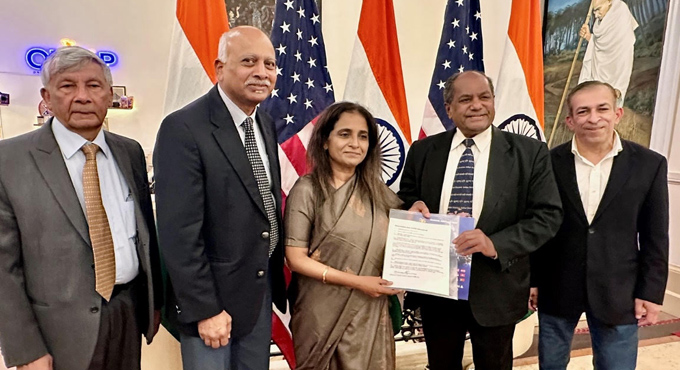
GOPIO International Chairman Dr. Thomas Abraham presented a memorandum to External Affairs Minister S. Jaishankar during his recent visit to New York, where he was attending an event at the Asia Society. The memorandum was compiled from feedback from members of the global Indian diaspora and covers consular, administrative, philanthropic, cultural and diaspora-engagement issues.
The document had earlier been presented on Sept. 26 to senior Ministry of External Affairs officials at a meeting organized by the Consulate General of India in New York. Those attending included Ambassador Sripriya Ranganathan, secretary responsible for Passport, Visa and Overseas Indian Affairs, and Anken Banerjee, joint secretary of the Diaspora Engagement Division.
A major recommendation was simplification of the Overseas Citizenship of India application process. GOPIO said the procedure should be more user-friendly and easier to navigate. It also called for a mechanism through which nonresident Indians and OCI cardholders could obtain Aadhaar cards where appropriate.
The organization highlighted obstacles faced by overseas Indians seeking to support legitimate charitable and philanthropic organizations in India. It said non-religious educational and social-service institutions can face difficulties receiving overseas contributions and urged the government to address these barriers.
GOPIO called for greater participation of overseas Indians at Pravasi Bharatiya Divas, including more diaspora speakers and panelists. It also urged the government to invite and appropriately recognize previous Pravasi Bharatiya Samman Award recipients at subsequent PBD events, describing them as an important resource for the global diaspora.
The memorandum proposed dedicated interactive sessions at Pravasi Bharatiya Divas involving officials from the Ministry of External Affairs and relevant Home Ministry offices and selected overseas Indian leaders. Such meetings could provide a direct forum for concerns and solutions.
Another recommendation was greater involvement of qualified NRI and PIO scientists, technology professionals and entrepreneurs in advisory committees of relevant ministries, including those dealing with science and technology, information technology, commerce and industry.
The memorandum also raised financial and travel concerns. GOPIO suggested exploring mechanisms that would allow overseas Indians to use foreign-issued credit cards for certain bill payments and other transactions in India. It also sought attention to visa difficulties faced by Pakistani American Hindu Sindhis wishing to travel to India for religious pilgrimages, visits to Ram Janmabhoomi, weddings, shopping and other cultural or family purposes.
Passport renewal was another concern. GOPIO pointed to difficulties faced by Indians in the United States who are out of status and receive only short-duration passports, requiring repeated renewals and lengthy processing. It suggested simplifying the process or considering longer-duration passports where appropriate.
It also called for youth-exchange initiatives to strengthen ties between India and second- and third-generation Indian Americans and other young members of the diaspora.
During the meeting, participating organizations raised additional concerns involving consular and passport services, overseas philanthropic contributions, cultural tourism, youth programs, and banking and financial transactions affecting naturalized citizens of Indian origin abroad. Participants also reiterated the need for Aadhaar access and proposed memorials recognizing the history of Indian indentured laborers and an Indian Diaspora Museum in New Delhi.
Representing GOPIO were Abraham, Mahesh Jhangiani, president of GOPIO-CT, and Prof. Raj Vanagapty, president of GOPIO-Manhattan. GOPIO described the memorandum not as a list of grievances but as constructive proposals designed to strengthen the relationship between India and its global diaspora.
“The global Indian diaspora represents a tremendous resource for India,” Abraham said, adding that the organization’s objective is to help overseas Indians contribute more effectively to India’s development while receiving responsive services from the government.
GOPIO said it plans to continue its dialogue with the Indian government and relevant ministries on these and other issues affecting overseas Indians. Founded in 1989, GOPIO is a non-partisan, not-for-profit, secular organization with more than 100 chapters in 35 countries.