By Prashant Shah
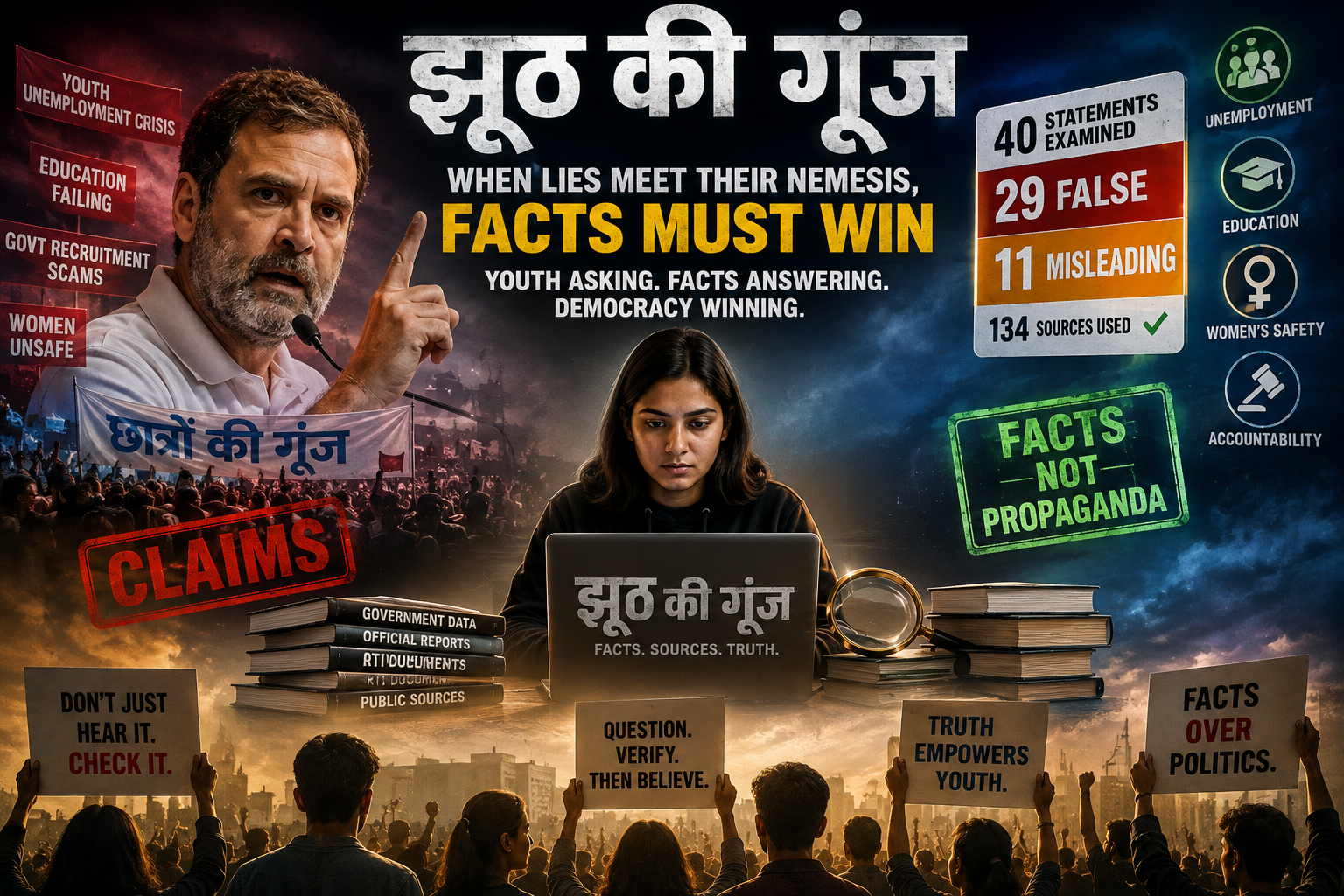
Rahul Gandhi has spent considerable political energy trying to convince India’s youth that he is the voice of a new generation. Through his “Chhatron Ki Goonj” campaign, he has taken his message directly to students and young voters, speaking on unemployment, recruitment, education, women’s safety and other issues that matter deeply to Gen Z.
But there is now an unexpected complication for the Congress leader: “Jhooth Ki Goonj.”
The very generation Rahul Gandhi is attempting to influence appears to be fighting back in the language of the digital age. The website has taken 40 statements attributed to Gandhi at four recent student-focused events and subjected them to a claim-by-claim examination. Its verdict is devastating: 29 statements are classified as false and 11 as misleading, backed, according to the site, by 134 sources, including government data.
That is not a minor political rebuttal. It is a direct challenge to the idea that a powerful political narrative can be established simply by repeating it loudly enough.
Rahul Gandhi may have created “Chhatron Ki Goonj” to make his political message echo among students. “Jhooth Ki Goonj” has cleverly turned the same strategy against him. The names themselves reveal the battle: one seeks to amplify a political narrative; the other seeks to test that narrative against facts.
And that is precisely what democracy needs.
The most significant aspect of this development is not whether the website has BJP sympathies. Political neutrality in an intensely polarized environment is always difficult to establish. What matters first is whether the claims being challenged are supported by evidence. Every politician—Rahul Gandhi included—must expect scrutiny when making serious assertions about unemployment, government recruitment, education, crime or women’s safety.
Congress has every right to question the website’s motives. It can challenge its evidence, methodology and conclusions. But dismissing the entire exercise merely because it is politically inconvenient would be a serious mistake.
At the same time, intellectual honesty requires us to draw a line between what is known and what is alleged. The BJP has openly amplified “Jhooth Ki Goonj.” BJP leaders have publicly cited it as a counter to Gandhi’s campaign. That is a documented political fact. But there is still no conclusive public evidence proving that the BJP created, owns or finances the website. Congress may allege that it is a BJP operation, but an allegation is not proof.
The mystery surrounding its founder is equally intriguing. Social-media claims identify the founder as a 20-year-old woman and allege that she faced threats from Rahul Gandhi’s public-relations team. Those claims remain unverified. A young woman named Samantha has publicly supported the initiative, but that does not establish that she is its creator.
In our view, the identity of the founder is less important than the substance of the work. Let the claims be examined independently. Let the sources be checked. Let every disputed statistic be tested. If “Jhooth Ki Goonj” is wrong, expose it. If Rahul Gandhi is wrong, expose him too.
What India does not need is another political echo chamber where supporters applaud everything their side says and condemn everything said by the other side.
What India needs is a culture in which facts are the ultimate political weapon.
Rahul Gandhi has every right to speak to India’s youth. But India’s youth also have every right to question him. They are not passive consumers of political messaging anymore. They are digitally connected, skeptical and increasingly capable of checking claims for themselves.
That may be the real message behind “Jhooth Ki Goonj.”
The political class can shout.
The youth can verify.
And when propaganda collides with facts, facts must have the last word.