By Prashant Shah
For nearly two years, millions of immigrant families across the United States have lived under a cloud of fear and uncertainty. Their concerns extended far beyond immigration paperwork, visa renewals, or green card backlogs. They worried about something infinitely more precious—the future of their children born on American soil. Parents who came to this country legally to pursue education, careers, and the American Dream suddenly found themselves asking whether their children's birthright as American citizens could be taken away by executive action. It was a question few ever imagined would arise in a nation built upon constitutional guarantees and the rule of law.
Since the beginning of President Donald Trump's second term, the White House has issued a series of executive orders touching nearly every aspect of immigration, border security, citizenship, and federal authority. Supporters have praised these actions as bold leadership and a fulfillment of campaign promises to strengthen immigration enforcement. Critics, however, argue that the administration's aggressive reliance on executive orders has created confusion, undermined confidence in America's legal institutions, and deepened anxiety within immigrant communities that have contributed immensely to the nation's prosperity.
On the very first day of his second term, President Trump signed an executive order seeking to end automatic birthright citizenship for certain children born in the United States, overturning more than a century of legal understanding of the Citizenship Clause of the Fourteenth Amendment. Challenging birthright citizenship had been one of Trump's central campaign promises. He repeatedly argued that the policy acted as "a magnet for illegal immigration" and vowed to end what he described as an abuse of the Constitution. Throughout his political career, Trump has made numerous controversial remarks about immigrants. He has described undocumented immigrants as "poisoning the blood of our country," comments that drew widespread criticism from civil rights groups and political opponents. His administration's approach reinforced the perception among many immigrant communities that it viewed immigration—legal and illegal alike—with increasing hostility.
Among all these executive actions, none generated greater controversy than the attempt to restrict birthright citizenship through executive authority. The proposal struck at one of the oldest constitutional principles in American history. For generations, the Fourteenth Amendment has guaranteed citizenship to those born in the United States, subject to limited legal exceptions. That guarantee has provided certainty not only for immigrant families but for the nation itself. It has represented America's enduring commitment that citizenship derives from constitutional principles rather than shifting political priorities.
The administration's effort immediately triggered a constitutional confrontation. Legal experts from across the ideological spectrum questioned whether a president could alter a constitutional right through executive order alone. Many argued that while a president possesses broad executive powers, those powers do not extend to rewriting constitutional protections established by the Fourteenth Amendment. The issue rapidly moved through the federal courts, placing millions of families in emotional limbo while awaiting the nation's highest judicial authority.
For immigrant parents, this was not an abstract legal debate. It became a daily source of fear. Families postponed buying homes, delayed business investments, reconsidered educational plans, and even questioned whether to expand their families. Pregnant women worried whether children born in American hospitals would continue to enjoy the constitutional protections that generations had taken for granted. Young professionals working under temporary visas wondered whether years of dedication and hard work would ultimately leave their children trapped in legal uncertainty. Community organizations, immigration attorneys, schools, and employers struggled to answer questions that no one could answer with confidence.
The emotional toll reached far beyond undocumented immigrants. Thousands of legal immigrants—including doctors, engineers, scientists, professors, entrepreneurs, researchers, nurses, and technology professionals—who have obeyed American laws, paid taxes, and helped build the nation's economy found themselves questioning whether their children's future would become hostage to political battles in Washington. Indian Americans, Asian Americans, Hispanic Americans, African immigrants, and countless other communities experienced the same uncertainty. For many, America had always represented stability under the Constitution. Suddenly, even that certainty appeared vulnerable.
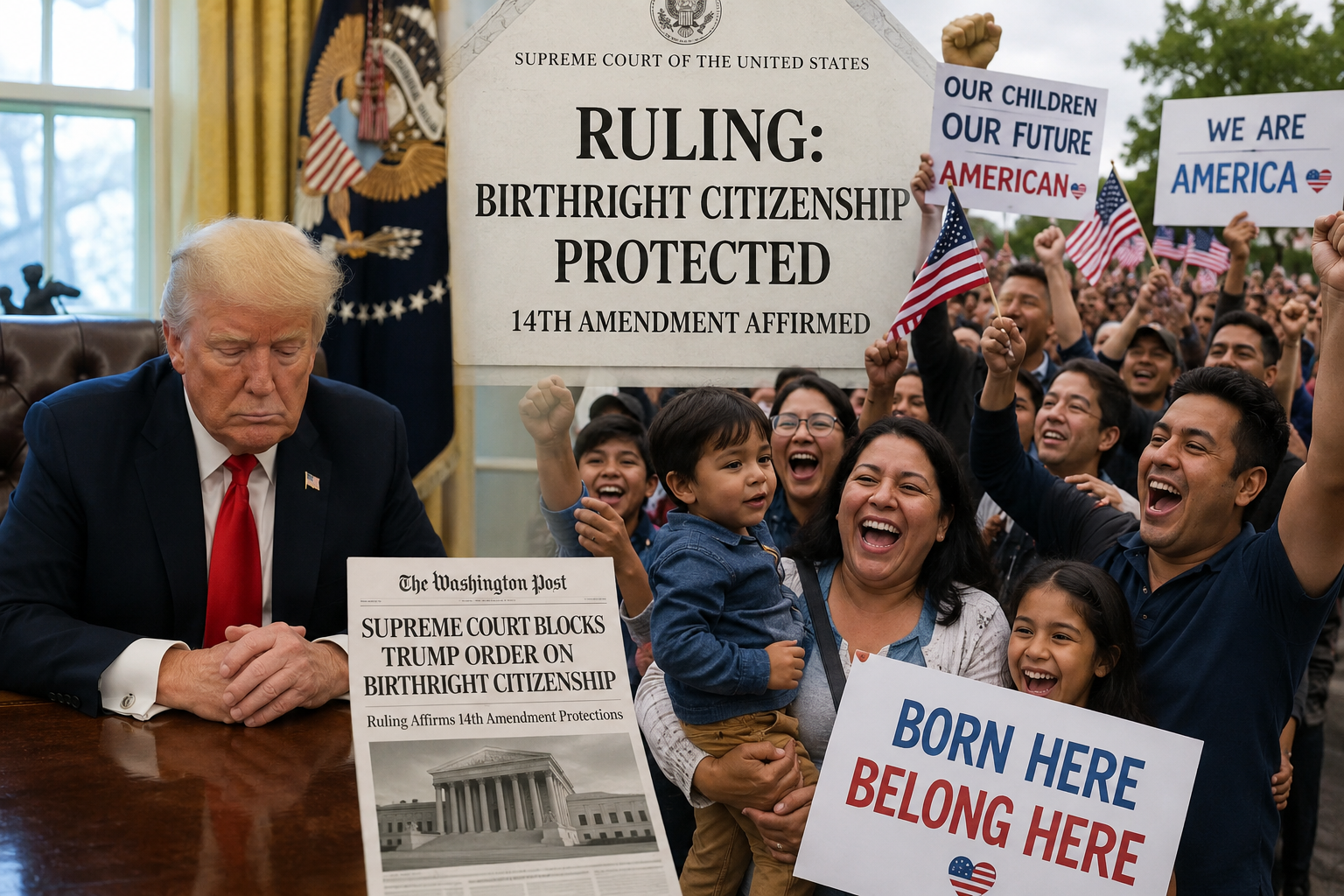
The Supreme Court's decision rejecting the administration's attempt to alter birthright citizenship through executive action restored hope to millions of immigrant families. More importantly, it reaffirmed one of the most fundamental principles of American democracy: no president, regardless of political popularity or electoral mandate, possesses unlimited constitutional authority. The Court reminded the nation that executive orders cannot override constitutional protections. Presidents enforce laws; they do not rewrite the Constitution.
The ruling serves as a powerful reminder that America's democratic system was intentionally designed to prevent excessive concentration of power. The Founding Fathers understood that unchecked authority, regardless of who exercised it, threatened liberty itself. They therefore created three independent branches of government, each serving as a constitutional safeguard against overreach by the others. Congress writes the laws. The President executes them. The Judiciary interprets them. That balance remains the cornerstone of American democracy.
The Supreme Court's decision also sends an important message about the nature of presidential leadership. Winning an election—even by a convincing margin—does not grant unlimited authority. A democratic mandate allows a president to govern, pursue policy priorities, and fulfill campaign promises within the boundaries established by the Constitution. It does not authorize unilateral alteration of constitutional rights that belong to all Americans.
The debate over birthright citizenship has also revived America's long tradition of embracing diversity. In sharp contrast to today's political divisions, former Republican President Gerald Ford once observed that "'Black is Beautiful' was a motto of genius which upheld our nation far above its intention. Once Americans had thought above it and perceived its truth, we began to realize that so are brown, white, red, and yellow beautiful." Ford's words reflected a vision of America in which citizenship and equality transcend race, ethnicity, and national origin.
Illinois Governor J.B. Pritzker sharply criticized President Trump's effort to restrict birthright citizenship, stating, "Trump's racism made him unable to understand that birthright citizenship helps make America great. He went after the 14th Amendment because making our country smaller was the only way he could make himself feel bigger." His remarks reflected the concerns of many opponents who viewed the executive order not simply as an immigration policy but as a challenge to one of the nation's defining constitutional principles.
President Trump has consistently argued that his administration is carrying out the will of the American people by strengthening border security and reducing illegal immigration. Those policy goals remain legitimate subjects for political debate and legislative action. However, the Court's decision makes clear that constitutional questions of citizenship cannot be settled through executive orders alone. If such fundamental changes are to occur, they must proceed through constitutional amendments or legislation consistent with constitutional requirements—not by presidential decree.
The broader consequences of prolonged uncertainty should not be underestimated. America's immigrant communities are among the country's greatest economic strengths. They operate businesses, create jobs, serve in hospitals, lead research laboratories, teach in universities, and drive innovation in science and technology. When millions of these families begin questioning their long-term future, uncertainty extends beyond individual households. Businesses postpone investments. Employers struggle with workforce planning. Consumers delay major financial decisions. Communities become increasingly polarized over issues that should instead be resolved through constitutional processes.
Confidence has always been one of America's greatest economic assets. Investors, entrepreneurs, employers, and workers all thrive when legal institutions remain stable and predictable. Prolonged constitutional uncertainty weakens that confidence. Regardless of political affiliation, every American benefits when constitutional questions receive clear judicial resolution rather than remaining subject to shifting executive interpretations.
The Supreme Court's decision therefore represents far more than an immigration ruling. It is a reaffirmation that the Constitution remains the supreme law of the land. It demonstrates that even the most powerful office in the world remains accountable to constitutional limits. That principle protects conservatives and liberals, citizens and immigrants, majorities and minorities alike.
As the United States has just celebrated the 250th anniversary of its founding, the Court's ruling serves as a timely reminder of the nation's enduring commitment to the fundamental principle of birthright equality. At a moment when Americans are reflecting on the ideals upon which the Republic was established, the decision reinforces that constitutional rights cannot be diminished by executive decree. The anniversary is not merely a celebration of the nation's past, but a reaffirmation that liberty, equality, and the rule of law remain the guiding principles that unite Americans across generations.
The political debate over immigration will undoubtedly continue. Congress may pursue new legislation. Future administrations may propose different policies. Voters will continue to express their preferences through elections. That is how democracy functions. But the constitutional foundation upon which those debates occur must remain protected from unilateral executive action.
For millions of immigrant parents, the Court's ruling restored something that had been steadily eroding during months of uncertainty—hope. Hope that their children will continue to enjoy the constitutional protections promised at birth. Hope that America's legal institutions remain stronger than temporary political conflicts. Hope that the rule of law still governs the nation more powerfully than the will of any individual leader.