Kolkata, Sep 14 (IANS) With the number of dengue-affected people in West Bengal climbing to over 5,000 this year so far, the state health department has identified 29 municipalities, 85 community development blocks and 278 village panchayats as the hotspots.
An insider from the State Health Department said its workers are focusing on more intensive and random blood sample tests in these municipalities, blocks and panchayats, considering that the maximum number of dengue-positive cases in the last month have been reported from these hotspots.
According to him, the department was following a particular formula for identifying such hotspots. “A village panchayat having 10 or more dengue patients is identified as a hotspot panchayat. Similarly, if more than 30 people in a community block have dengue, it is identified as a hotspot block. A municipality is identified as a hotspot if the majority of wards there have five or more dengue-affected persons,” an official said.
At the same time, he added, the department is also focusing on extensive awareness drives at these hotspots, asking people with dengue symptoms, such as continuous fever for two or more days, to voluntarily coming forward for blood tests.
‘What has kept us especially worried is that in many of these hotspots, people having fever for two or more days are often resorting to self-medication instead of consulting any medical practitioner. This is aggravating the crisis. So, we are conducting massive awareness drives urging people to refrain from self-medication in cases of continuing fever for two or more days and instead reach the nearest health centres for blood tests or consult a nearest medical practitioner,” said the official.
At the same time, the health department staff are conducting door-to-door surveillance to prevent dengue. “The health workers are asking people to keep the water tanks and cisterns of the house covered. If a cover cannot be provided, they should be covered with mosquito nets or nets. Awareness is being raised about preventing water from accumulating in flowerpots and abandoned containers on the roof,” the state health department official said.
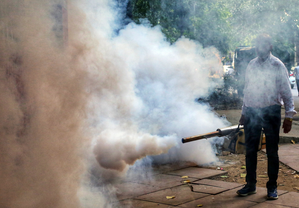
The health department is also conducting surveillance in ponds, drains, pools, dry canals, unused wells, and factories. Larvicides are also used according to the guidelines.
On Sunday, the health department published its latest dengue bulletin, showing 5,002 affected people till September 11. However, the alarming factor is that the total number of dengue-affected people till the same date in August was less than 2,500. This means that over the last month, 2,500 additional individuals have been affected by dengue.
According to the latest statistics provided by the department, the maximum number of affected people so far has been from the Murshidabad district at 1,072, followed by Kolkata at 500 and North 24 Parganas at 450.