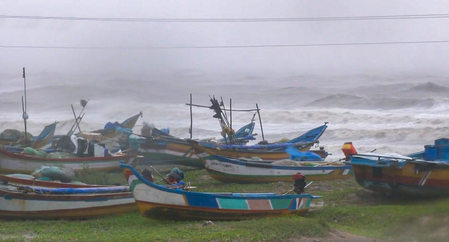
Visakhapatnam, Nov 16 (IANS) The deep depression over Southeast and adjoining Southwest Bay of Bengal intensified into Cyclonic Storm ‘Akvan’, the India Meteorological Department said on Monday.
It lay centred at 1730 hrs IST on November 16, about 610 km from Chennai, 660 km from Machilipatnam, 670 km from Visakhapatnam, and 790 km from Gopalpur (Odisha)
It is likely to intensify into a severe cyclonic storm by the evening of November 17 and a very severe cyclonic storm by the evening of November 19.
‘Akvan’ is likely to cross Andhra Pradesh and Yanam coasts between Nellore and Tuni around noon on November 20 as a very severe cyclonic storm with winds of 120–130 kmph gusting to 145 kmph.
According to Prakhar Jain, Managing Director of the Andhra Pradesh State Disaster Management Authority and CEO of Real Time Governance Society (RTGS), the cyclone is moving at a speed of 10 km per hour.
Moving in a west-northwesterly direction, it is likely to strengthen into a very severe cyclonic storm by November 19 morning. Fishermen have been warned not to venture out to sea.
Due to the cyclone, heavy rains are expected in parts of Coastal Andhra Pradesh starting November 18. Extremely heavy rainfall is likely on November 19 and 20.
Prakhar Jain said for cyclone-related assistance, people can contact the 'Mana Mitra' WhatsApp number 9552300009. For emergency help, people can call 112, 1070, or 18004250101
SDMA said people in coastal areas should remain alert. The public and farmers have been advised to take precautionary measures.
It listed the precautions to be followed by everyone to prevent loss of life and property due to the impact of a cyclone.
It urged people to remain calm, avoid believing rumours, and not give in to panic. It is advised to keep mobile phones charged and stay updated with weather information provided by disaster management agencies, the RTGS and the IMD.
Important documents and certificates should be stored in waterproof covers, and a kit containing at least a week’s supply of food and drinking water should be prepared. Precautionary measures, such as checking the security of the roof, doors, and windows of the house, should also be taken.
During the cyclone, those at home should switch off the main electrical supply, disconnect gas connections, and keep all doors and windows firmly shut. If a house is deemed unsafe, it is advisable to move to a designated relief centre in advance. Only boiled and cooled water should be consumed. If there are signs that a building might sustain sudden damage, one should seek shelter under a sturdy table or bench.
Residents in low-lying areas prone to flooding are urged to relocate to higher, safer ground as soon as instructed by the authorities. If caught outdoors during the cyclone, one must avoid entering damaged or dilapidated buildings. Prakhar Jain advised people against standing under trees, hoardings, or electricity poles.