Deepika Bhan
New Delhi, May 24 (IANS) Few creatures invite as much dislike as cockroaches do, which is why it is weird that the same insect has suddenly become the centre of fascination for a section of people who otherwise would never hesitate to eliminate it. The cockroach has managed to create such a buzz that it is now trending across social media, gathering followers in massive numbers.
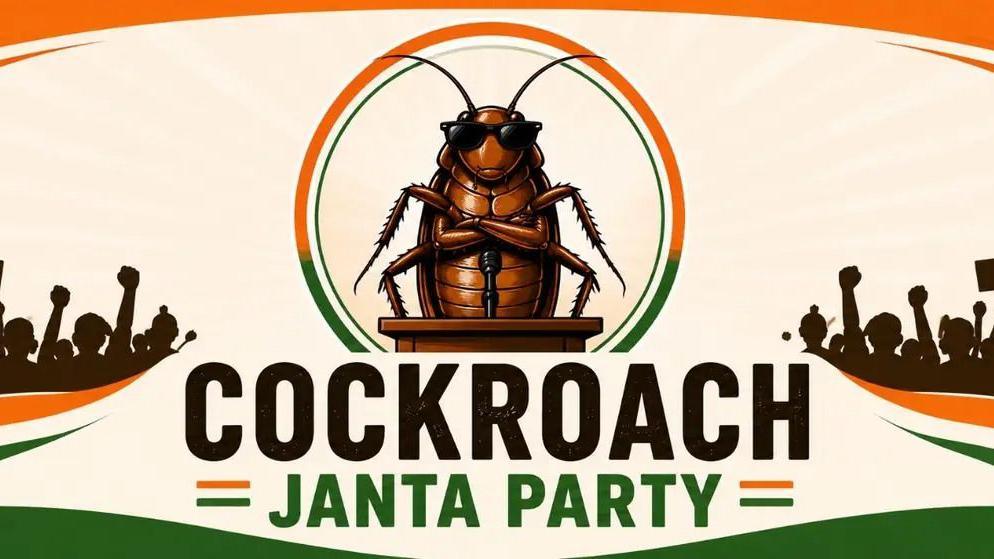
In a democracy, divergent views and satire have always had space. They often reflect the vibrancy of public discourse. So, when an Indian student studying at a foreign university decided to channel his mischievous creativity into a satirical political idea built around a cockroach, the reaction that followed was far larger than anyone might have anticipated.
Even the student himself, Abhijeet Dipke from Maharashtra's Chhatrapati Sambhajinagar district, may not have expected the scale at which his so-called 'Cockroach Janta Party' (CJP) would resonate online.
There is nothing inherently wrong with satire. India has a long tradition of using humour and mockery to question authority. Long before the digital age, newspaper cartoons served as some of the sharpest political commentaries. Satirical 'mushairas' ridiculed governments through poetry, while in recent years, stand-up comedy and online content have emerged as powerful tools of political expression. In that sense, the rise of something like the CJP is not extraordinary in itself.
But questions inevitably arise. Can a single student, operating independently, generate such a widespread digital storm? That seems unlikely. Given how political narratives are increasingly shaped online, and considering similar developments witnessed in countries such as Nepal, Bangladesh and Sri Lanka, suspicions about larger backing naturally emerge.
Dipke's association with the Aam Aadmi Party is part of the public record now. Reports suggest he was linked to the party between 2020 and 2023 and volunteered with its social media team. Some accounts also claim that he participated in the AAP's digital campaigning during the 2020 Delhi Assembly election, won by the Arvind Kejriwal-led party.
This has led to speculation that the CJP may not be entirely independent but could instead resemble a politically driven digital experiment. The CJP seems to be trying to ape the India Against Corruption movement launched by Anna Hazare, which Kejriwal later used to form the AAP. Whether that comparison is fully justified or not, time will tell, but the parallels are being discussed.
The timing of the CJP's rise has added another layer to the debate.
In recent weeks, Kejriwal's confrontation with the judiciary has intensified. The friction became visible after his appearance on April 13 before Delhi High Court judge Justice Swarana Kanta Sharma in connection with the excise policy case, where he argued for her recusal. Clips of the courtroom exchange quickly spread across social media.
Later, on April 27, Kejriwal wrote to Justice Sharma stating that he would neither appear before her personally nor through legal counsel. Claiming he had "lost hope" of receiving justice from the judge, he said he would follow Mahatma Gandhi's path of 'satyagraha'. Manish Sisodia adopted a similar line, and both leaders later visited Raj Ghat.
A strong social media campaign accompanied these developments, with attempts to portray both Kejriwal and the AAP as victims in the judicial process. Justice Sharma eventually recused herself from the matter, while also initiating contempt proceedings against Kejriwal, Sisodia, Sanjay Singh, Saurabh Bharadwaj and others over alleged attempts to undermine the court's integrity online.
Amid these developments came the announcement of the CJP. The launch followed shortly after remarks were attributed to Chief Justice of India Surya Kant involving the words "parasites" and "cockroaches" during court proceedings on May 15. Although clarification later emerged that the comments had been misinterpreted.
The CJP also attempted to build momentum around the NEET paper leak controversy. Dipke's first public campaign involved an online petition demanding the resignation of Union Education Minister Dharmendra Pradhan. He also released a video message urging students and young people to mobilise around the issue. Notably, these videos appeared days after Kejriwal publicly appealed to students on May 12 to protest over the NEET controversy.
Politics rarely functions in isolation, and Dipke's old social media posts reflecting his admiration for Sisodia and commitment to the AAP have further fuelled speculation. One such post, written before he left for Boston, thanked Sisodia for the opportunities provided to him and reaffirmed his support for the party. A photograph of the two together has also resurfaced online.
Whether the CJP is truly an AAP-backed digital movement on the lines of IAC remains open to interpretation. But the episode certainly raises broader questions.
How easily can online narratives be manufactured? How vulnerable are young audiences, especially Gen Z users, to highly packaged political messaging emerging from outside the country?
Equally notable is the attention the platform has begun receiving in sections of the international media. Some political parties in India, particularly within the Opposition, are now openly or indirectly speaking in favour of the CJP, perhaps without fully realising what its sudden rise actually reflects.
Had the Opposition in India remained consistently constructive and not entirely indulged in BJP-hate mongering politics, the political space would never have been left open for something symbolised by a cockroach to occupy it.
That is what makes the trend unsettling. Political satire has its place in a democracy, but when public frustration begins finding expression through symbols associated with decay and disorder, it points to a deeper vacuum in the opposition ecosystem.
People understand what a cockroach represents. And just as it is never allowed to breed unchecked in homes, democratic spaces too must remain cautious.
(Deepika Bhan can be contacted at deepika.b@ians.in)