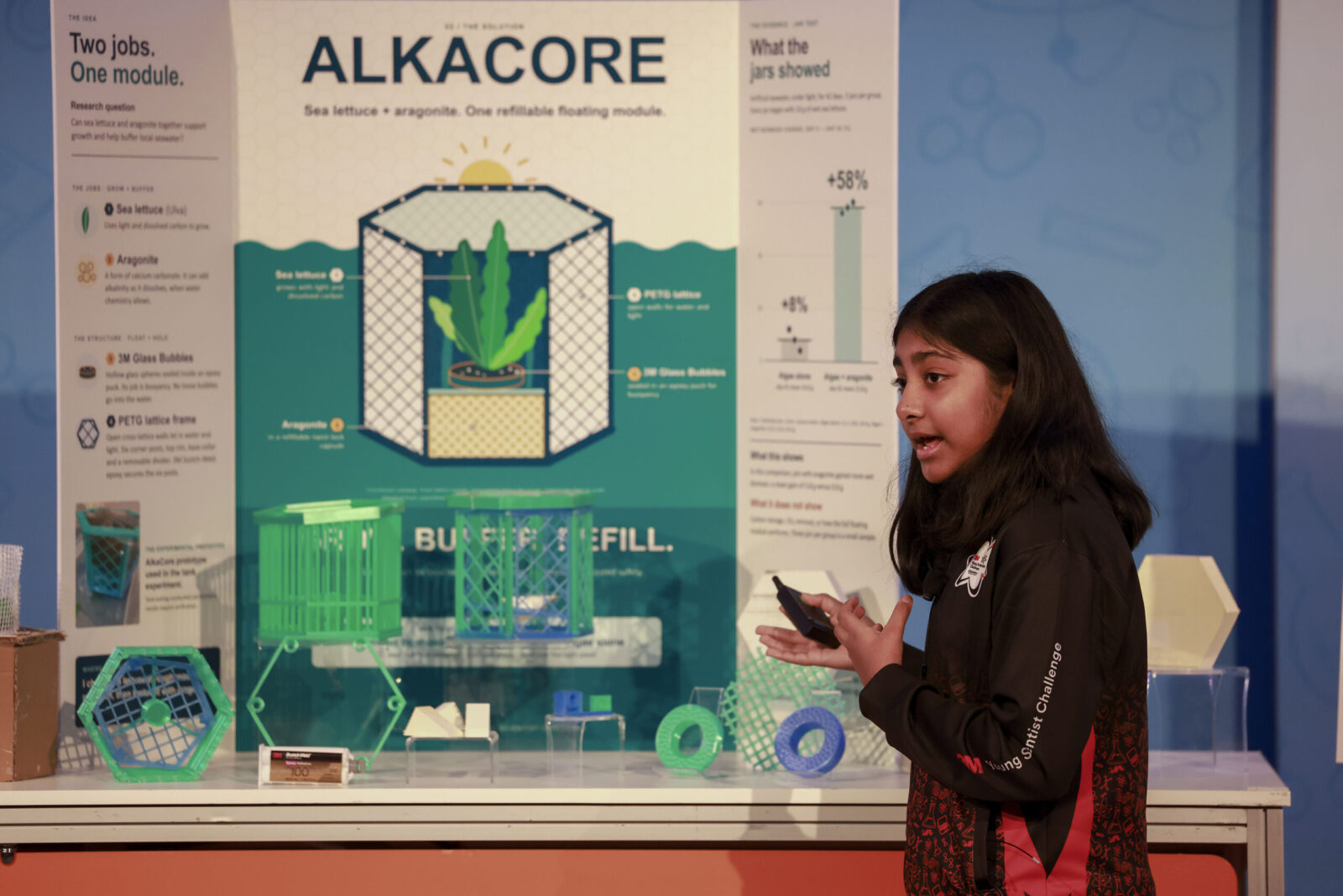
ST. PAUL, Minn: A 13-year-old student from Connecticut has earned national recognition for developing an innovative scientific approach to combat ocean acidification, a growing environmental threat that endangers marine life and ecosystems. Raji Doshi, an eighth-grader who lives in Farmington, Connecticut, has been named “America’s Top Young Scientist” after winning the 2026 3M Young Scientist Challenge, one of the nation’s leading science competitions for middle school students.
Doshi won the prestigious title for engineering a natural algae-and-aragonite system designed to increase seawater alkalinity and reduce carbon dioxide levels. Her project earned her a $25,000 cash prize and recognition for demonstrating how scientific curiosity, research and innovation can help address a pressing global environmental challenge.
Organized by 3M and Discovery Education, the competition concluded with final events at 3M’s global headquarters in St. Paul, Minnesota, on October 12 and 13. Doshi emerged victorious from a field of 10 finalists, ages 11 to 14, who spent the summer developing and refining their scientific ideas with the guidance of professional scientists.
Her project, titled Engineering a Novel Durable Algae-Aragonite Alkalinity System to Reduce CO2-Driven Ocean Acidification, explores whether cultivating macroalgae alongside aragonite, a naturally occurring form of calcium carbonate, could provide a durable and affordable method of reducing acidification in coastal waters.
Ocean acidification occurs when seawater absorbs carbon dioxide from the atmosphere, triggering chemical changes that lower its pH. These changes can make it more difficult for marine organisms, including shellfish and certain types of plankton, to build and maintain their calcium carbonate shells and structures. The resulting damage can threaten marine food chains and the communities that depend on healthy oceans.
Doshi investigated how the combination of algae and aragonite could help counter these effects. Through chemical analysis, she demonstrated that aragonite could increase algae biomass, promote carbon dioxide removal and substantially reduce dissolved carbon dioxide levels. She also developed a computational model based on Michaelis-Menten kinetics to determine an optimal aragonite dosage, an important step toward making the proposed system more efficient and practical for coastal communities.
Her interest in the problem began with a personal passion for collecting seashells. Concerned that ocean acidification was threatening shells and the marine creatures living inside them, she sought to develop a solution that could help protect ocean ecosystems. She named her proposed innovation ALKACORE.
Deborah Isabelle, a product engineering specialist at 3M who mentored Doshi throughout the competition, said the young scientist's concern for marine life inspired her research and helped transform her interest into a potential real-world solution.
William Brown, 3M chairman and chief executive officer, congratulated Doshi, noting that the competition demonstrates the potential of young people to use science and creativity to tackle real-world challenges. Brian Shaw, chief executive officer of Discovery Education, similarly emphasized the importance of encouraging students to pursue their curiosity and turn ideas into practical innovations.
The second- and third-place honors went to Aaisha Asif, a seventh-grader from Sarasota, Florida, and Sharvi Mahajan, a ninth-grader from San Diego, California. Both received $1,000 prizes. Seven other finalists from across the United States also received recognition for their scientific creativity and ingenuity.
Now in its 19th year, the 3M Young Scientist Challenge pairs each finalist with a 3M scientist who provides individual mentorship throughout the summer, helping transform an initial concept into a working prototype. Participants are evaluated on creativity, scientific understanding, communication, research, ingenuity and their application of science, technology, engineering and mathematics.
Previous winners have gone on to deliver TED Talks, file patents, establish nonprofit organizations and earn places on the Forbes 30 Under 30 list.
Doshi's achievement highlights how young innovators can contribute fresh ideas to complex environmental problems. Although further testing would be needed to establish the system's effectiveness, durability, cost and suitability for large-scale use, her research represents an encouraging example of youth-led scientific inquiry directed toward protecting the planet's oceans.
(Courtesy: 3M)