By Lalit Gargg
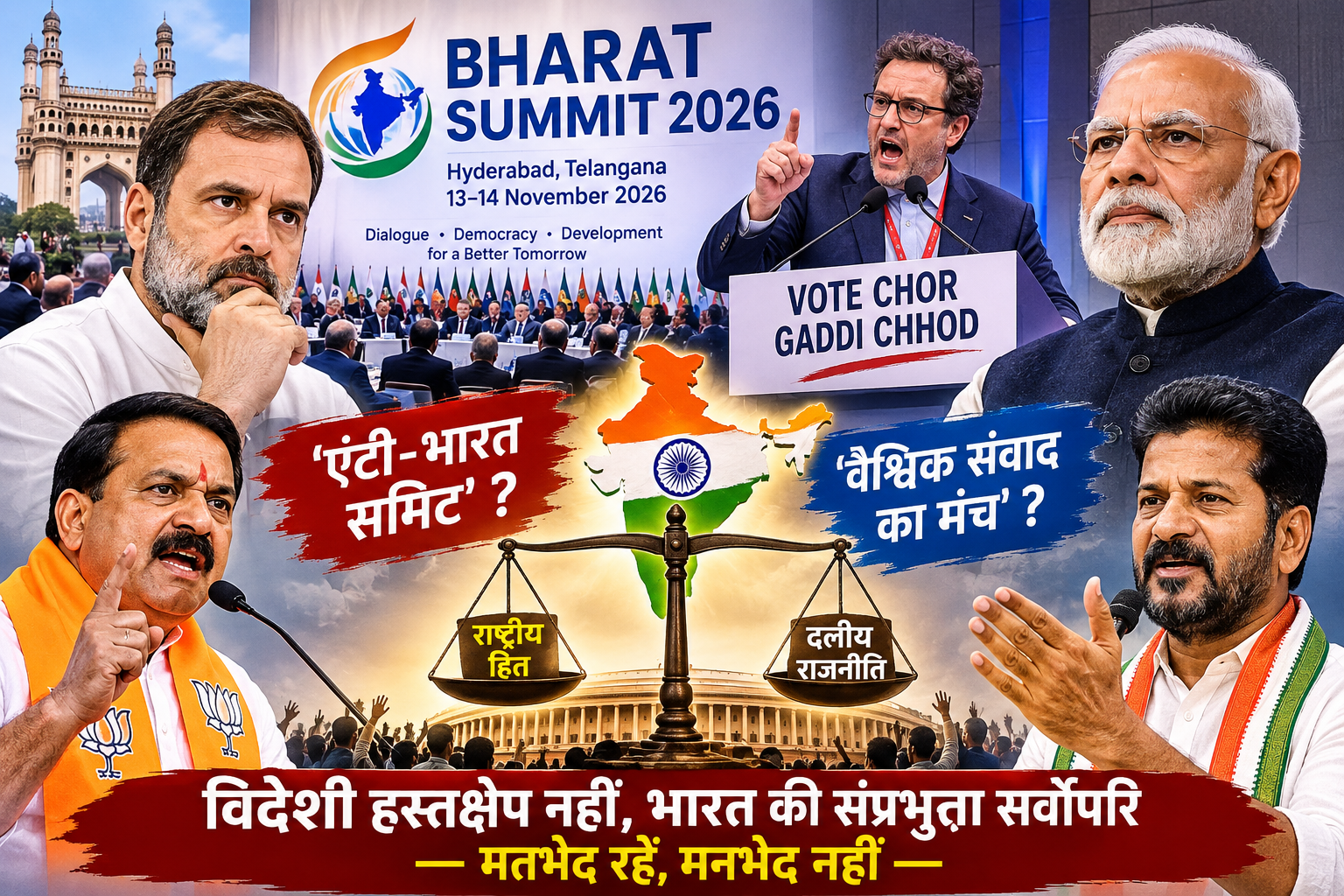
The greatest strength of democracy is that it provides ample space for dissent against those in power. Questioning government policies, scrutinising its decisions, exposing shortcomings and presenting an alternative political vision are not merely constitutional rights of the Opposition; they are also essential democratic responsibilities. But when foreign political forces are given a platform to oppose an elected government, and domestic political disputes are transformed into matters of international political discourse, the issue ceases to be merely political. It becomes a question of national self-respect, sovereignty and democratic propriety. The ‘Bharat Summit’, held in Hyderabad on November 13–14, 2026, has become the centre of a political controversy for precisely this reason. The Congress and the Telangana government have presented it as an international platform for deliberation on global challenges—climate change, artificial intelligence, economic justice, investment, democracy and development. The BJP, on the other hand, has cited remarks made by some foreign speakers to describe it as an ‘Anti-Bharat Summit’. Both sides have their political arguments. Yet, beneath this political confrontation lies a far more serious question: Can the involvement of foreign political forces in India’s domestic politics be accepted as a normal part of democratic discourse? This question must not be examined merely from the standpoint of support for or opposition to any particular political party. It deserves to be judged on the larger test of national interest.
There is nothing inherently wrong with inviting foreign scholars, economists, environmental experts and democratic thinkers to India. India has always believed in the civilisational ideal of Vasudhaiva Kutumbakam—the world is one family. Dialogue with the international community is a strength of Indian civilisation. Issues such as climate change, artificial intelligence, the global economy, war, peace and human rights cannot be confined within national borders. International dialogue on such subjects is both necessary and desirable. The problem begins when global dialogue turns into political propaganda, and foreign political personalities are encouraged to make allegations against India’s elected government, electoral process or democratic institutions without publicly substantiated evidence. The reported remarks of Italian socialist leader Giacomo Filibeck at the Hyderabad conference triggered precisely such a controversy. His questioning of India’s electoral system in the presence of Rahul Gandhi, along with the reported use of the slogan “Vote Chor, Gaddi Chhod”, further sharpened the political debate.
The fundamental question here is not whether a foreign citizen has the right to express an opinion about India’s democratic system. In a free society, such opinions may certainly be expressed. The real question is: Should foreign political leaders be turned into active participants in India’s domestic political battles? In a democracy, governments are changed by the people—not by foreign powers. If an Indian political party believes that there are shortcomings in the electoral system, it has Parliament, the judiciary, the Election Commission, the media and, above all, the people of India. It can challenge electoral outcomes, approach the courts, produce evidence and take its case directly to the people. But when a political party begins relying on foreign political platforms and foreign politicians to reinforce its domestic allegations, it ultimately risks weakening its own democratic credibility. A serious question therefore needs to be addressed to the Congress: Has faith in India’s democratic institutions weakened to such an extent that foreign voices are now required to validate its political allegations? But the same question must also be addressed to the BJP. It would be equally undemocratic to label every international conference as ‘anti-India’ or every criticism of the government as a ‘foreign conspiracy’. India is a mature and confident democracy. It does not need to fear criticism; it can answer criticism with facts, reason and institutional strength. An inappropriate or provocative statement by a foreign visitor should certainly be questioned and opposed where necessary, but every disagreement cannot automatically be branded as anti-national.
The most troubling aspect of this controversy is the apparent blurring of the distinction between India’s foreign policy and partisan domestic politics. Foreign policy does not belong to the Congress, the BJP or any other political party. It represents the collective aspirations and strategic interests of the Indian nation. Governments change; political equations change; electoral outcomes change—but the nation endures. From the legacy of the Non-Aligned Movement to today’s increasingly multipolar world, India has maintained its independent foreign-policy identity. It has built relationships with the United States, Russia, Europe, Japan, the Arab world, Africa and the Global South on the basis of its national interests. For a country of India’s stature, it is essential that domestic political differences should not be converted into international political conflicts. Opposing a government is not the same as opposing the nation. But inviting foreign political forces to actively participate in India’s internal political battles is certainly a matter of serious concern. Understanding this distinction is crucial for the future of Indian democracy.
National unity does not mean the disappearance of the Opposition. It means that political parties may have different ideologies and governments and Opposition may fiercely criticise each other, but their fundamental commitment to India’s interests, sovereignty and democratic institutions must remain shared. If a political party wants to return to power, it must go before the people. It must offer credible alternatives on unemployment, inflation, education, healthcare, agriculture, youth aspirations, women’s security and economic development. Merely declaring that democracy is in danger is not enough. A claim that democracy is under threat demands evidence. The answer to electoral defeat is not a foreign platform but public trust. At the same time, the government and the ruling party must also engage in introspection. When the Opposition raises questions about democracy or the electoral process, those concerns should not simply be dismissed as political propaganda. Transparency, institutional credibility and meaningful dialogue are essential to strengthening public confidence. Trust in democracy is not created by speeches alone; it is built through the conduct of institutions.
India is emerging as one of the world’s major economies, and its influence on global platforms is expanding. At such a moment, carrying domestic political battles to international platforms could establish a dangerous precedent—one that could eventually be used against any political party. If foreign intervention in domestic politics is normalised today against one political formation, the same instrument could be used against another tomorrow. Therefore, the issue should not be reduced to Congress versus BJP. The larger question is India versus political opportunism. If the ‘Bharat Summit’ genuinely seeks to create a new platform for India’s engagement with the world, it deserves appreciation. But if a platform organised in the name of Bharat becomes a vehicle for importing domestic political battles into the international arena, questions about its purpose and propriety are bound to arise.
India does not need to fear foreign ideas. India has always welcomed intellectual exchange and global dialogue. But the political destiny of India must ultimately be determined by the people of India alone. Power is neither granted by foreign approval nor taken away by foreign criticism. In a democracy, it comes from the mandate of the people—and ultimately returns to the people. The true strength of democracy lies in our ability to criticise the government fearlessly, listen to the arguments of the Opposition and engage with ideas from across the world, while ensuring that the final authority remains with the Indian citizen. Let there be political differences, but not national divisions. Let there be fierce debate, but no compromise on sovereignty. Let there be competition for power, but never at the cost of national interest. Governments may change. Political equations may change. Electoral outcomes may change. But India’s unity, integrity and democratic sovereignty are greater than the political strategy of any individual party. That is the true dignity of Indian democracy—and that is its enduring national strength.